*Potential spoilers ahead*
Rating: 4.5 diamonds
Publisher: Simon Pulse
Blurb: Kiko Himura has always had a hard time saying exactly what she’s thinking. With a mother who makes her feel unremarkable and a half-Japanese heritage she doesn’t quite understand, Kiki prefers to keep her head down, certain that once she makes it into her dream art school, Prism, her real life will begin.
But then Kiko doesn’t get into Prism, at the same time her abusive uncle moves back in with her family. So when she receives an invitation from her childhood friend to leave her small town and tour art schools on the West Coast, Kiko jumps at the opportunity in spite of the anxieties and fears that hold her back. And now that she is finally free to be her own person outside the constricting walls of her home life, Kiko learns life-changing truths about herself, her past, and how to be brave.
Likes: There is so much I love about this book.
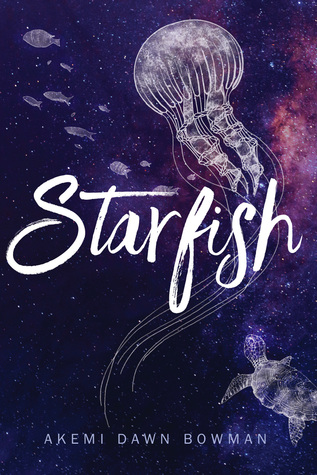
- The cover: it’s amazing, the art is fantastic and indicative of what Kiko likes, and it just makes me feel calm all around. The copy of Starfish that I have is a hardcover, so there’s a dust jacket that you can take off to reveal the actual book, which is a pretty purple color. The title is done in a sort of glossy finish with the artwork in the background is what seems to be a very light purple or a purplish-hued white. One the back is a small quote from the book–“I draw a very small fish swimming in the ocean and realizing it’s filled with planets and stars”–with the essential information on the bottom (ISBN number, author website, publisher’s website).
- The characterization: I have a love/hate relationship with the dynamic between Kiko and her mother, Kiko and her father, and essentially Kiko and everyone else. I love how, from the get-go, we see that Kiko is regularly dismissed by her mother and treated as if she is less than. We see that Kiko has mainly one friend and her relationships with others are non-existent.
- Kiko’s mother: You see from the very beginning that Kiko’s mother is selfish and narcissistic. She thinks only of herself and how things will impact her, not her children. She lets Kiko’s abusive uncle back into their home even when she knows that Kiko has problems with him and then dismisses Kiko’s complaints as her trying to make a problem out of nothing.
- Kiko’s brothers: You don’t see much of them although they are more present nearer to the end of the book. There’s an obvious distance between her and her siblings, and it shows by how often she mentions how much she misses them–which is little.
- Kiko’s father: he’s a mild-mannered man seen only a couple of times in the book and I really see why things didn’t really work out.
- The growth: Kiko slowly but surely grows in the book. At the beginning, she doesn’t speak her mind, instead choosing to show her thoughts in sections titled “What I Want to Say” and “What I Actually Say” rather than just letting them be simple thoughts that pass through and not get any attention. Nearer to the end, she’s become more confident and a bit more outspoken as she leaves a toxic environment to one that’s more accepting of her.
Dislikes:
- Kiko’s family interactions: while I love seeing the dynamics of the Himura family, I really wish I had seen some semblance of a blooming relationship with Kiko and her brothers. After Kiko has to return home after a certain incident, I thought that maybe it would have been time to actually close the distance between each other and actually talk things out. Sadly, that didn’t happen.
- Kiko’s mother: goodness, I hate that woman, and that’s how you know a character is written well. Kiko’s mother is mean and is subtly racist, which in turn makes Kiko turn away from her Japanese heritage and for part of the book. Add in the fact that she makes everything situation about her rather than her kids and what impact it will have on them, and she’s just one woman that you’d love to hate. She couldn’t even be your problematic fave.
- Kiko’s decision to leave: from the synopsis, I thought that this was going to be a road-trip type of situation where Kiko finds herself amidst the vast roads as she travels to the west coast and finds herself then. I thought that there would be more art schools that she would tour. There wasn’t. It was more of a simple plane ride and then a tour of like two or three schools.
Would I Read This Again?
Definitely. There was something about Kiko that resonated with me, especially as someone who has just graduated from an educational institution. There were qualities in her mother that I saw in family members, and then there was a distance that I maintain with people that she also maintains. Sometimes I wished that she would just combust and confront her mother earlier on, but as someone who doesn’t like conflict and has felt beaten down, I understand why it took so long for her to do so. Though this book is meant for a younger audience, adults can read this and relate to it as well. I would totally recommend this if someone asked for a contemporary novel with self-reflection, toxic family and friends, and a happy, open ending. I applaud Akemi Dawn Bowman for writing a fantastic debut novel that hit me in all of the feels.
 kannaree.com
One reply on “Starfish, Akemi Dawn Bowman”
[…] that focus more on a character than the plot, and the most immediate book that I can think of is Starfish by Akemi Dawn Bowman. (this is my review from 2017. Please be aware of mild spoilers.) There is a mild plot to it, […]
LikeLike